You just found out the company you’ve been courting is also talking to your neighboring city
And neither of you knew about it until the site selector mentioned it casually on a call. Now you’re competing against your own region. The company sees two municipalities scrambling instead of one coordinated pitch. Three weeks later, they announce they’re opening a facility in another state entirely. This happens across the country every month. Not because economic developers are bad at their jobs, but because their CRM systems were built for individual organizations, not regional collaboration. The bottom line: Purpose-built economic development CRM software works well for individual organizations. But when your mission extends beyond municipal boundaries to regional economic competitiveness, these single-org tools fall short. Regional economic development requires shared intelligence, coordinated action, and the ability to present a unified front. That requires a platform-based economic development CRM, not a single-purpose tool.
What is economic development CRM? Economic development CRM software helps EDOs manage business relationships, track prospect pipelines, coordinate retention programs, and measure economic impact. While standard CRMs focus on sales, economic development CRM systems handle unique workflows like site selection, FDI tracking, BRE visits, and regional collaboration.
The regional collaboration gap in economic development CRM
Economic regions do not follow municipal boundaries. A business considering relocation to your area does not care whether your city ends at a particular street. Site selectors evaluate regions, not individual municipalities. Yet most economic development organizations operate on CRM systems designed for single-organization use. This creates a fundamental mismatch between how economic development actually works and how most EDO software is built.
The problem with competing rather than coordinating
When neighboring municipalities each maintain their own CRM with no visibility into regional activity, several problems emerge: Duplicated effort and missed intelligence. Multiple EDOs may contact the same business without knowing it. One municipality might learn that a company is considering expansion while another remains unaware. The left hand does not know what the right hand is doing. Internal competition that benefits external regions. When two cities within the same region compete aggressively for the same prospect, they often end up driving the business to an entirely different metro area. The “winner” of internal competition loses the company to a region that presented a coordinated pitch. Inconsistent regional messaging. Site selectors hear different stories from each municipality they contact. Without a shared view of regional assets, workforce data, and available sites, the region appears fragmented and disorganized. Lost opportunities for combined impact. A prospect requiring more land, workforce, or infrastructure than any single municipality can provide might find a solution through regional coordination. But if EDOs cannot easily collaborate on deals, these opportunities disappear. According to Business Retention & Expansion International, existing businesses account for most local employment changes. Research consistently shows that 70-80% of net new job growth comes from existing businesses rather than new business attraction. Regional coordination on business retention prevents losing these employers to other states entirely.
The real cost nobody talks about
Here’s what keeps regional EDO directors up at night: Your board asks why the neighboring county landed three projects this quarter while you landed one. You can’t explain that you actually identified two of those prospects first—but had no way to coordinate the handoff. Your state economic development agency rolls out a grant program requiring regional partnerships. You scramble to cobble together data from three different municipal CRM systems that don’t talk to each other. The application deadline passes while you’re still reconciling spreadsheets. A site selector tells you off the record that your region “seems disorganized” compared to others they’re evaluating. Each municipality gave them different workforce numbers, different available sites, different incentive structures. They went somewhere else. These aren’t hypothetical scenarios. Ask any regional EDO director.
By the numbers:
- 70-80% of net job growth comes from existing businesses (BREI)
- $350M+ in private investment from 50 years of regional coordination (Greater Egypt RPC)
- 22,300+ projected jobs from multi-county collaboration grants (ARC ARISE)
- $625M capital investment in Hampton Roads’ record-breaking 2023
What regional EDOs need that single-org CRMs cannot provide
The gap between single-organization tools and regional collaboration requirements is significant: Partner portals for cross-municipality visibility. Staff from different EDOs need appropriate access to shared pipeline information without compromising sensitive data. Purpose-built EDO CRM software like ExecutivePulse and ProTRACKPlus does not offer this capability because it was designed for individual organizations. Shared dashboards without compromising data ownership. Regional leadership needs aggregate views of activity across all partner municipalities. Individual organizations need their own metrics. The system must support both without forcing everyone into a single database structure. Workflow routing across organizational boundaries. When a prospect inquiry comes to one municipality but would be better served by a neighbor, the system should facilitate warm handoffs rather than requiring manual coordination. Regional reporting alongside individual metrics. Grant applications, board presentations, and stakeholder communications increasingly require demonstrating regional impact. Cobbling together reports from multiple disconnected systems wastes time and produces inconsistent data.
Salesforce as a force multiplier for regional economic development
The term “force multiplier” comes from military strategy: a capability that significantly increases the effectiveness of a force. For regional economic development, a shared platform creates this effect by amplifying what individual organizations can accomplish alone. Salesforce, built as a platform rather than a single-purpose application, enables the kind of regional collaboration that purpose-built EDO CRM software cannot support.
Experience Cloud enables partner collaboration
Salesforce Experience Cloud (formerly Community Cloud) provides the foundation for regional EDO collaboration. It allows organizations to create partner portals where authorized users from different municipalities can access shared information, collaborate on deals, and maintain visibility into regional activity. Key capabilities for regional EDOs include:
- Controlled access levels for each partner organization without exposing sensitive municipal data
- Real-time messaging through Chatter across organizational boundaries
- Shared document libraries for proposals, site information, and marketing collateral
- Coordinated calendars for business visits, trade shows, and regional events
Unified view of regional pipeline while maintaining autonomy
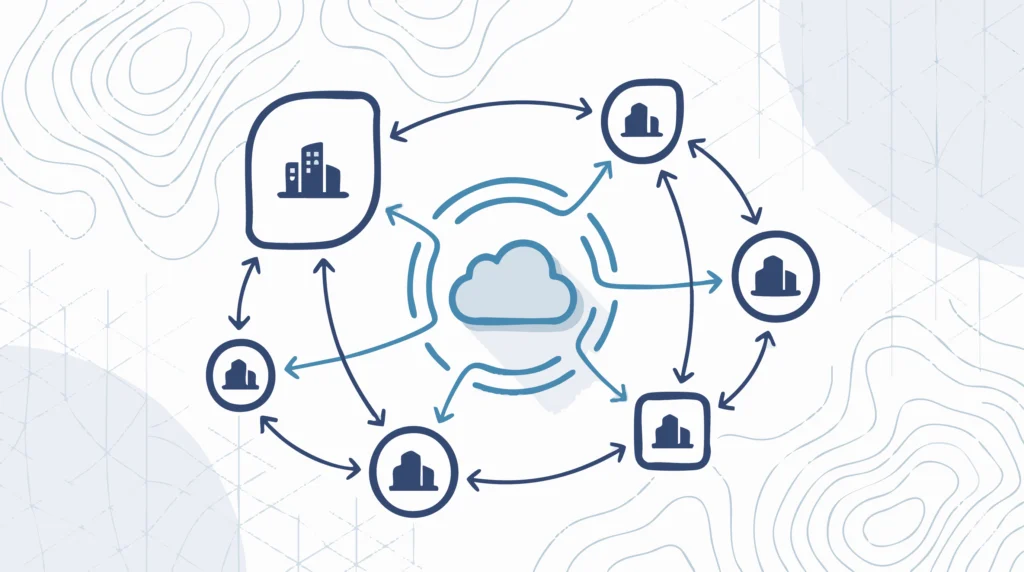
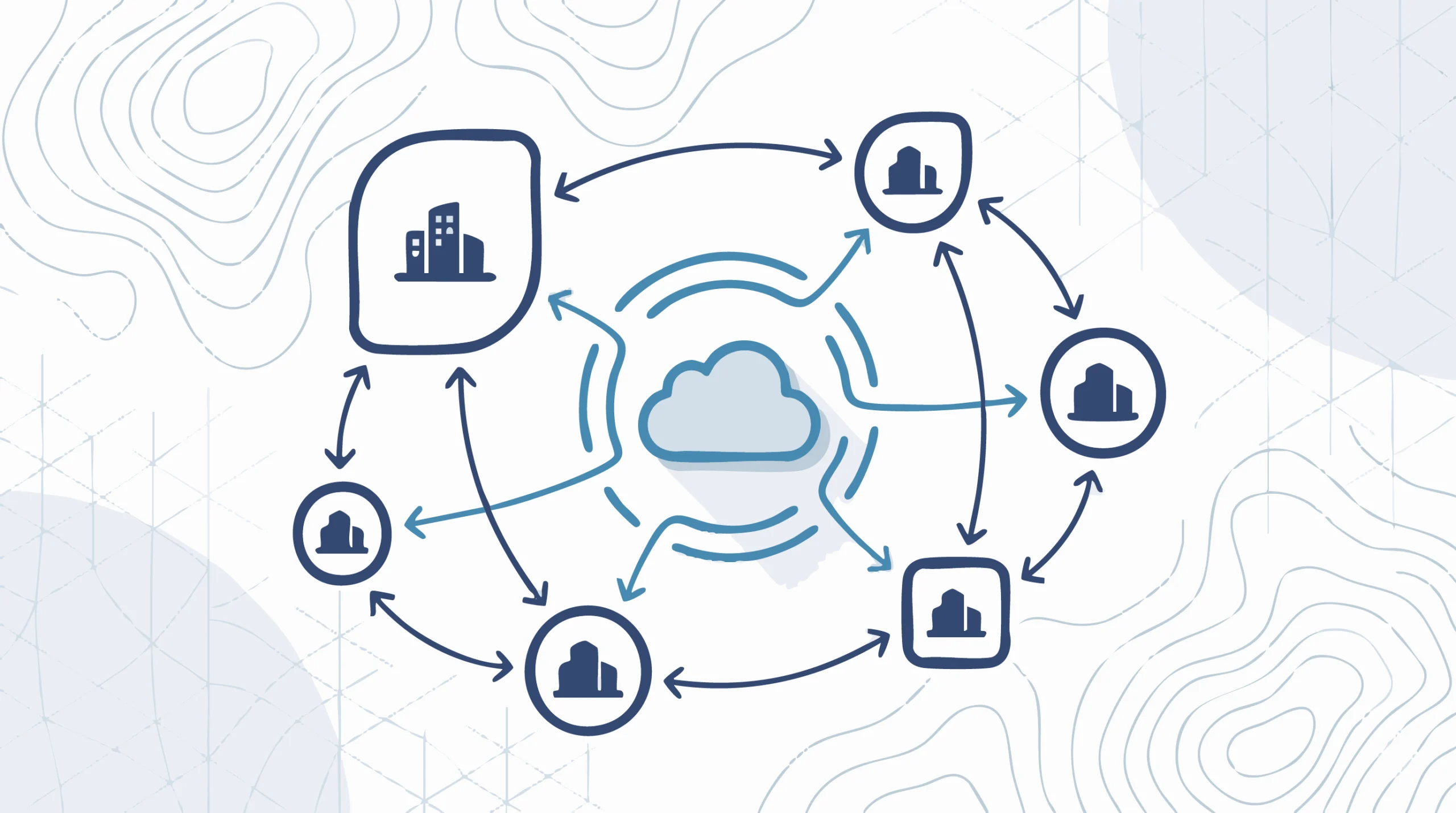
The platform approach allows each municipality to maintain its own records while contributing to a regional view. This balance is critical. Economic developers are accountable to their own elected officials and stakeholders. They cannot simply merge all data into a regional bucket. Salesforce handles this through:
- Record sharing rules: Define exactly what information is visible to whom
- Role hierarchies: Regional staff can see aggregate data while municipal staff focus on their territories
- Custom objects: Track both municipal-level and regional-level metrics
- Dashboard permissions: Each audience sees relevant views of the same underlying data
Integration with existing municipal systems
Most municipalities already have technology investments. Property databases, permitting systems, workforce development platforms, and GIS systems contain valuable information. Purpose-built EDO CRMs typically offer limited integration options, requiring manual data entry and creating silos. Salesforce provides:
- Pre-built connectors: Over 1,000 applications integrate natively through AppExchange
- API flexibility: Connect to custom municipal systems through REST and SOAP APIs
- Data synchronization: Keep information current across systems automatically, ensuring data quality across the region
- Single source of truth: Reduce duplicated data entry and inconsistencies
How the platform approach differs from purpose-built EDO CRMs
The economic development CRM market includes several purpose-built options. ExecutivePulse claims over 2,100 users and positions itself as “built by economic developers, for economic developers.” ProTRACKPlus offers seven integrated modules with 90% customizable fields. These tools serve individual EDOs well. They understand the language of business retention and expansion (BRE), foreign direct investment (FDI) pipelines, and impact reporting. A BRE CRM built for single organizations provides faster implementation than a platform approach, making it suitable for straightforward needs. But they were not designed for regional collaboration.
Comparing capabilities for regional needs
|
Requirement |
Purpose-Built EDO CRM |
Salesforce |
|
Single EDO operations |
Strong |
Strong |
|
Partner portals for regional collaboration |
Not available |
Experience Cloud |
|
Cross-organization dashboards |
Not supported |
Yes, with sharing rules |
|
Integration with municipal systems |
Limited |
Extensive ecosystem |
|
Scalability as region grows |
Constrained |
Platform-level |
|
AI-powered insights |
Limited or none |
Einstein Analytics |
|
Mobile access for field staff |
Basic |
Native applications |
|
Custom application development |
Vendor-dependent |
Low-code/pro-code options |
|
Security and compliance |
Varies |
SOC 2, FedRAMP options |
Mobile access for field economic developers
Economic developers spend significant time outside the office—visiting businesses, attending site tours, representing their regions at conferences. Mobile CRM access isn’t optional; it’s how work actually gets done. Salesforce mobile enables real-time updates during:
- BRE visits: Capture notes, action items, and concerns immediately while context is fresh
- Site selector tours: Access property data, demographic info, and regional assets on-device
- Trade shows and conferences: Log interactions and sync with regional partners instantly
- Regional partner meetings: View shared dashboards and collaborate through Chatter
Purpose-built EDO CRMs typically offer basic mobile web access. Salesforce provides native iOS and Android applications with offline capabilities.
Security and compliance for government organizations
Regional collaboration involves sharing sensitive economic data across organizational boundaries. Government organizations have specific security requirements that purpose-built CRMs may not address:
- Role-based access controls ensuring appropriate data visibility across partner organizations
- Audit trails tracking who accessed what information and when
- FOIA-compliant record retention and export capabilities
- SOC 2 Type II certification for enterprise security standards
- FedRAMP authorization options for federal grant compliance
- Encryption at rest and in transit for all data
When multiple municipalities share a platform, security architecture matters more than features.
When purpose-built CRM makes sense
Purpose-built EDO CRM software is the right choice when:
- Your organization operates independently without significant regional coordination
- Integration with other municipal systems is not a priority
- Your team prefers industry-specific terminology and workflows out of the box
- Budget constraints make a platform approach impractical
- You need to be operational quickly with minimal configuration
When Salesforce makes sense
Salesforce becomes the better choice when:
- Regional collaboration across multiple municipalities is a strategic priority
- You need to integrate with existing government or municipal systems
- Your organization requires advanced analytics and reporting capabilities
- Scalability matters because your region or responsibilities may grow
- You want a platform that can expand to other use cases beyond economic development
Case study: Building a regional Salesforce platform for Hampton Roads
The Hampton Roads region of Virginia illustrates what regional collaboration looks like in practice. The Hampton Roads Alliance represents 14 localities, including 10 cities and 4 counties, working together on business attraction, retention, and regional economic competitiveness.
The challenge: transparency and communication across 14 jurisdictions
As a regional economic development organization, the Hampton Roads Alliance faced a common challenge: ensuring transparency with partner municipalities while enabling effective communication across the region. Each locality had its own priorities, constituents, and reporting requirements. Yet they shared a common interest in regional economic growth. The Alliance set out to create a collaborative workspace that would enhance workflow and allow more effective communication internally and throughout the region with partner colleagues. This was not a new idea. Regional Salesforce had been discussed for years. Turning that idea into reality required both technical expertise and understanding of how economic development organizations actually work.
The solution: a virtual collaborative workspace
Port & Starboard worked with the Hampton Roads Alliance to build a regional economic development CRM platform designed for multi-municipality collaboration. The implementation addressed several key requirements: Shared visibility with appropriate boundaries. Partner municipalities can see regional pipeline activity and collaborate on opportunities without compromising sensitive local data. Each organization maintains control over what they share. Consistent processes across the region. Standard workflows for business visits, referrals, and follow-up ensure that prospects receive a coordinated experience regardless of which municipality they initially contact. Training and change management. Technology alone does not create collaboration. The implementation included training for users across all partner organizations, helping staff understand how to work effectively within the shared platform. Ongoing optimization. The platform continues to evolve based on how the Alliance and its partners actually use it. New customizations address emerging needs without disrupting existing workflows.
The outcome: 25-year record broken
In 2024, the Hampton Roads Alliance broke records again with nearly $1 billion in announced capital investment, following their best year in 25 years in 2023.. What changed? Site selectors who previously heard 14 different pitches now get one coordinated regional story. Partner municipalities that used to discover they were competing now share pipeline visibility. Grant applications that once required weeks of data wrangling now pull from unified regional dashboards. The Alliance describes Port & Starboard as “invaluable partners who made the long-talked idea for a regional Salesforce platform into a reality.” The platform didn’t guarantee those results. But it removed the collaboration barriers that had held the region back for years.
Lessons from regional economic development collaboration
Building technology for regional collaboration requires more than technical implementation. Several principles guide successful deployments:
Start with clear governance before technology
Who decides what data is shared? How are referrals handled between municipalities? What happens when two partners pursue the same prospect? These governance questions must be resolved before configuring the platform. Technology can enforce agreed-upon rules, but it cannot substitute for political alignment.
Respect individual organization autonomy
Regional collaboration works when partners maintain their own identities and accountability. The platform should enhance what individual EDOs can accomplish, not subsume them into a regional bureaucracy. Each municipality still reports to its own elected officials and stakeholders.
Build for shared wins rather than competition
The system should make collaboration easier than competition. When sharing a lead with a better-positioned neighbor is simpler than hoarding it, regional cooperation becomes the default. Design workflows that reward coordination.
Invest in change management and training
Staff accustomed to working in organizational silos need support to adopt collaborative practices. Training should address not just how to use the platform but why regional collaboration benefits everyone. Ongoing reinforcement helps new behaviors become habits.
What regional collaboration looks like in practice
The abstract concept of regional collaboration becomes concrete through specific use cases:
Business attraction: coordinated approach to site selectors
When a site selector contacts one municipality about a project, the regional platform enables:
- Immediate visibility that the inquiry exists (without revealing confidential details)
- Ability to assemble regional assets that match the project requirements
- Coordinated response presenting the region’s full capabilities
- Shared tracking of follow-up activities and outcomes
Rather than hearing inconsistent messages from multiple contacts, the site selector experiences a unified regional pitch.
Business retention: regional intelligence prevents loss to other states
Existing businesses often consider relocation. If they are unhappy with their current location, they may explore options. A regional BRE CRM enables collaboration that means:
- Early warning when a business is at risk, shared across affected jurisdictions
- Coordinated response addressing concerns regardless of which municipality originally learns about the issue
- Ability to offer regional solutions (alternative sites, workforce from broader area)
- Prevention of losses to competing regions through combined effort
According to Results for America, city-county collaborations advance economic development more effectively than siloed approaches. “By working together, cities and counties are able to identify financial efficiencies and solve problems more effectively together than alone.”
Workforce development: shared programs across municipalities
Workforce challenges do not respect municipal boundaries. Workers commute across city lines. Training programs benefit from regional coordination. A shared platform enables:
- Visibility into workforce development initiatives across the region
- Coordination with community colleges and training providers
- Tracking of outcomes at both municipal and regional levels
- Unified messaging to employers about available talent
Grant management: coordinated applications for regional impact
Federal and state grants increasingly favor regional approaches. The Appalachian Regional Commission’s ARISE program specifically targets multi-county collaborations, projecting over 22,300 jobs and $274.6 million in leveraged private investment through regional partnerships. A shared platform supports:
- Identification of grant opportunities that require regional collaboration
- Coordinated applications with consistent data
- Tracking of grant-funded activities across participating municipalities
- Reporting on regional outcomes to grantors
Impact reporting: regional story alongside local metrics
Stakeholders increasingly want to understand regional economic performance. Boards, elected officials, and state agencies ask questions that span municipal boundaries. The platform enables:
- Aggregate regional dashboards showing combined activity and outcomes
- Individual municipal views for local reporting requirements
- Consistent definitions and methodologies across the region
- Credible regional story supported by unified data
Is Salesforce the right economic development CRM for your EDO?
Choosing an economic development CRM involves more than comparing feature lists. The right answer depends on your organization’s situation and priorities.
Questions to ask before choosing a platform
What is your regional collaboration strategy? If you operate primarily as an independent municipal EDO with limited regional coordination, purpose-built tools may suffice. If regional collaboration is a strategic priority, platform flexibility matters. What systems do you need to integrate? Assess your existing technology landscape. Property databases, permitting systems, workforce platforms, and GIS systems may contain valuable data. Consider how each CRM option connects to these systems. What are your reporting requirements? Grant applications, board presentations, and stakeholder communications drive reporting needs. Evaluate how each option supports the reports you actually need to produce. How might your needs evolve? Economic development organizations grow and change. New initiatives, expanded territories, and additional partnerships create new requirements. Consider which platform can adapt. What is your budget, including long-term costs? Purpose-built EDO CRM systems typically range from $50-$200 per user/month with lower implementation costs ($10,000-$50,000). Salesforce involves platform licensing ($25-$150+ per user/month) plus implementation costs that can range from $50,000-$250,000+ depending on complexity. But total cost of ownership includes ongoing customization, integration maintenance, and scaling expenses over time. The real ROI question: what’s the cost of one missed regional opportunity because your systems don’t support collaboration?
Quick decision guide
Consider Salesforce if you answer YES to 3+ of these:
- You collaborate with 3+ partner municipalities regularly
- You need to integrate with 5+ existing municipal systems
- Your team size or territory may expand in the next 3 years
- You require partner portals with controlled data sharing
- Regional grant applications are a significant part of your funding
- You value platform flexibility over out-of-box EDO terminology
The importance of implementation partner expertise
Salesforce is a platform, not a turnkey solution. Success depends significantly on implementation. A partner who understands both the technology and economic development will deliver better outcomes than one who knows only Salesforce or only your industry. Look for partners who can demonstrate:
- Experience with economic development organizations specifically
- Understanding of BRE, business attraction, and regional collaboration concepts
- Ability to configure Salesforce for your workflows rather than forcing you into generic patterns
- Ongoing support beyond initial Salesforce implementation
The gap between you and regions that have this figured out is growing
Your region competes with regions that already coordinate effectively. While you’re manually reconciling data across disconnected systems, they’re presenting unified pitches backed by integrated regional intelligence. That gap gets wider every quarter. The good news: this is fixable. The Hampton Roads Alliance went from “long-talked idea” to functioning regional platform. The Greater Egypt Regional Planning & Development Commission helped attract over $350 million in private investment and create more than 7,000 jobs over 50 years of regional coordination. If 14 jurisdictions can coordinate effectively, so can yours. But it starts with understanding whether Salesforce is actually the right fit—or whether a simpler solution makes more sense.
What a consultation looks like
We’ll spend 30-45 minutes understanding your regional structure, current systems, and collaboration challenges. No sales pitch. You’ll leave with:
- Clear assessment of whether a platform approach fits your region
- Rough scope of what implementation would involve
- Honest recommendation—even if that means we’re not the right fit
Schedule a consultation to discuss your regional economic development goals. Or explore our economic development services to see how we’ve helped organizations like the Hampton Roads Alliance build platforms that enable collaboration instead of competition.